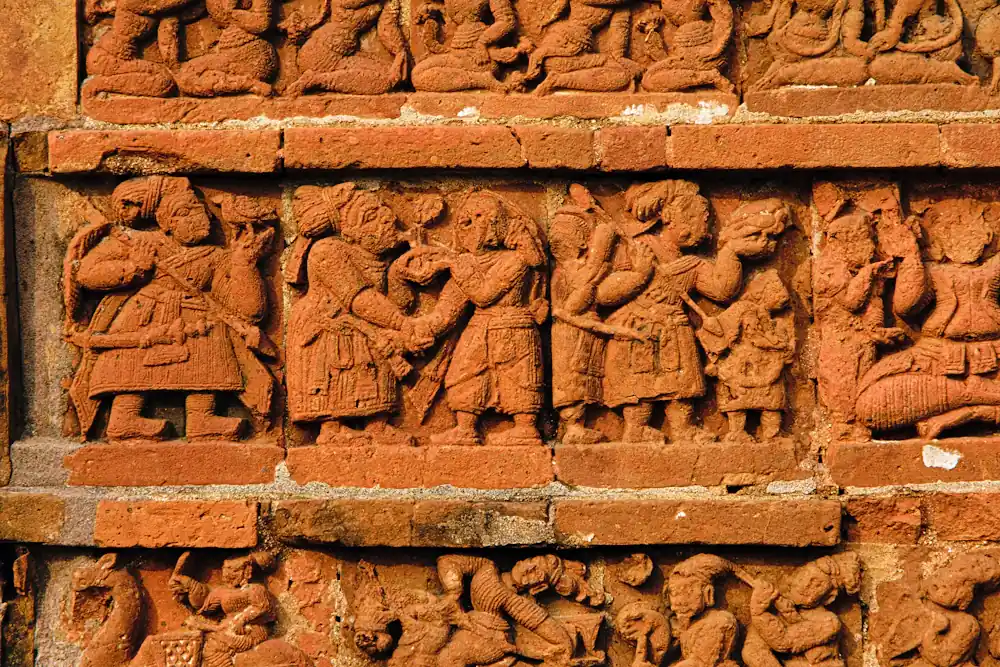
With little building stone in the delta, Bengal's temple builders worked in brick and fired clay. From the 17th to the 19th century local kings and merchants raised temples whose walls are covered in terracotta panels of epics, gods, hunts, boats and everyday life.
Bishnupur is the best-known centre, but fine examples survive across the state. Look out for the distinctive curved roofs, borrowed from village huts: the do-chala, the paired jor-bangla, and the many-towered ratna temples.
Bishnupur
Bishnupur is the temple town of Bankura district, famous for the brick and laterite temples built by the Malla kings in the 17th and 18th centuries, many covered in terracotta panels of scenes from the Ramayana, the Mahabharata and the life of Krishna. It is also known for Baluchari silk saris, terracotta crafts and its own school of classical music, the Bishnupur gharana.
Rasmancha
Rasmancha is the oldest brick temple in Bishnupur and the town's best-known landmark. King Bir Hambir of the Malla dynasty built it around 1600, not as a shrine for one deity but as a stage: during the Ras festival, the images of Radha and Krishna from temples across the town were brought here and displayed together for the people to see.
Jor Bangla Temple
The Jor Bangla Temple, also called the Keshta Rai temple, is perhaps the best-known terracotta temple in Bengal. King Raghunath Singha of the Malla dynasty built it in 1655 and dedicated it to Krishna, worshipped here as Keshta Rai.
Shyam Rai Temple
Shyam Rai Temple is the finest pancharatna, or five-spired, temple in Bishnupur, built in 1643 by the Malla king Raghunath Singha and dedicated to Krishna as Shyam Rai. Almost every surface, inside and out, is covered in terracotta panels, and its great circular Ras-chakra of Krishna dancing with the gopis is one of the best-known images of Bengal terracotta.
Madan Mohan Temple
Madan Mohan Temple is a single-spired brick temple in Bishnupur, built in 1694 by the Malla king Durjan Singha Dev and dedicated to Krishna as Madan Mohan. It has some of the richest terracotta in the town, with panels of the Dashavatara, the ten avatars of Vishnu, and of Krishna's life.
Lalji Temple
Lalji Temple is a single-spired temple in Bishnupur, built in 1658 by the Malla king Bir Singha Dev and dedicated to Radha and Krishna. Unlike the terracotta-covered Shyam Rai and Jor Bangla temples, it is built of stone with only fragments of surface decoration left, which makes its clean square form and gently sloping roof easier to appreciate.
Jor Mandir
Jor Mandir is a group of three single-spired temples in Bishnupur, built in 1726 under the Malla kings in the rust-red local laterite. Two large temples stand on either side of a much smaller one, and their walls carry carved scenes from the Ramayana and from Krishna's life.
Ambika Kalna
Ambika Kalna, usually just called Kalna, is a riverside town in Purba Bardhaman famous for its 108 Shiva temples, built in two concentric rings in 1809, and for the terracotta temples of the Rajbari complex opposite. Both were built by the Maharajas of Bardhaman and their queens in the 18th and 19th centuries, when the town was at its most prosperous.
108 Shiva Temples, Kalna
The 108 Shiva temples of Kalna, also called Nava Kailash, are the town's most famous sight: 108 small temples set in two concentric circles, built in 1809 by Maharaja Tej Chand of Bardhaman. Each temple holds a Shiva linga, and the plan is laid out so that all of them can be seen from the centre of the complex.
Kalna Rajbari Temple Complex
The Rajbari complex at Kalna is the walled ground of the old Bardhaman Raj palace, filled with some of the finest terracotta temples in Paschim Banga. Built between 1739 and 1849 by successive Maharajas of Bardhaman and their queens, it includes two great 25-pinnacled temples, Lalji and Krishnachandra, and the richly carved Pratapeswar temple.
Guptipara
Guptipara is a riverside village in the Balagarh block of Hooghly district, famous for the Brindabanchandra Math, a walled group of four Vaishnava temples from the 17th and 18th centuries with fine terracotta and murals. It is also remembered as the birthplace of the barowari, the community-funded Durga Puja, and for a Rath Yatra whose chariot travels further than almost any in India outside Puri.
Antpur
Antpur is a village in Hooghly district known for two things: the Radhagovindajiu Temple of 1786, about 100 feet high and covered in terracotta, and its place in the story of the Ramakrishna order. On the night of 24 December 1886, Narendranath (later Swami Vivekananda) and eight other young disciples of Sri Ramakrishna sat round a sacred fire here and vowed to renounce the world.
Char Bangla Temples, Baranagar
The Char Bangla temples are a group of four small Shiva temples at Baranagar, on the west bank of the Bhagirathi near Azimganj, built in the 18th century under Rani Bhabani of Natore. Each has a single curved hut-shaped roof, and two are covered in some of the finest terracotta in Murshidabad district.
Pathra
Pathra is a village about 18 km from Medinipur town on the bank of the Kangsabati, known as 'Mandirmay Pathra', the village of temples. It has dozens of small temples, 34 of them with terracotta decoration, built mostly in the 18th and 19th centuries by local landowning families.
108 Shiva Temple, Nawabhat
The 108 Shiva Temple complex at Nawabhat, on the edge of Bardhaman, is a group of 108 small temples to Shiva built in 1788 by Maharani Bishnu Kumari of the Bardhaman Raj. It is older than the better-known 108 temples of Kalna, built by her son, and after years of decay it was restored by the Birla Public Welfare Trust.