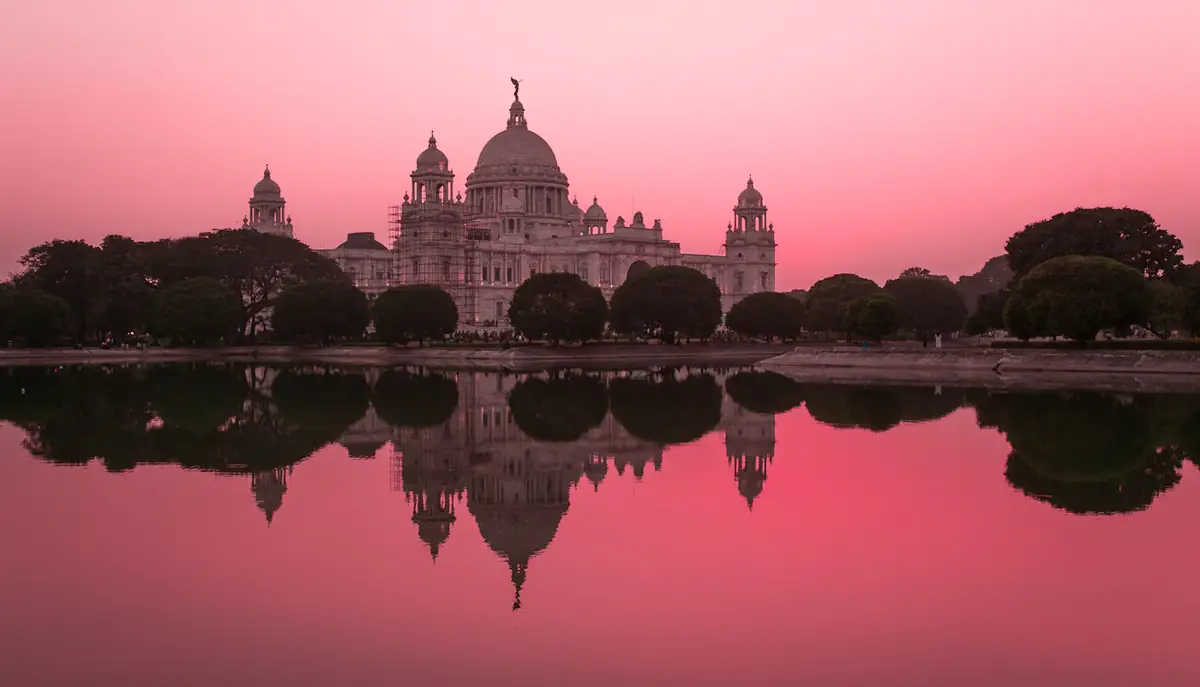
Kolkata was the capital of British India until 1911, and it gathered some of the country's oldest collections: the Indian Museum, founded in 1814, the Asiatic Society and the Victoria Memorial. Beyond the city, palaces, poets' homes and excavated sites have become museums of their own.
Most museums close one day a week and some on public holidays; check the current timings and ticket rules on each page before you go, and expect restrictions on photography.
Indian Museum
The Indian Museum on Chowringhee (Jawaharlal Nehru Road) is the oldest museum in India and one of the largest, with collections that grew from those of the Asiatic Society in 1814. In Bangla it is simply the Jadughar.
Victoria Memorial
The Victoria Memorial is a domed hall of white Makrana marble on the southern edge of the Maidan, built as a memorial to Queen Victoria and now a museum of the history of Kolkata and British India. It is the city's best-known landmark and the most visited of its museums.
Jorasanko Thakur Bari
Jorasanko Thakur Bari is the ancestral home of the Tagore family in north Kolkata, where Rabindranath Tagore was born in 1861 and where he died in 1941. The complex of mansions round a large courtyard now belongs to Rabindra Bharati University, and its main building houses the Rabindra Bharati Museum, devoted to the poet and to the family that played such a large part in the 19th-century Bengal Renaissance.
Netaji Bhawan
Netaji Bhawan is the family house of Subhas Chandra Bose on Elgin Road (Lala Lajpat Rai Sarani) in Bhowanipore, now a museum, archive and library run by the Netaji Research Bureau. Built by his father Janakinath Bose in 1909, it is the house from which Bose escaped British house arrest in January 1941, and the car he left in still stands in the drive.
The Asiatic Society
The Asiatic Society in Kolkata is one of the oldest learned societies in Asia, founded by the scholar William Jones on 15 January 1784 to study the history, languages and sciences of Asia. Its building at the corner of Park Street and Chowringhee has been its home since 1808.
Marble Palace
The Marble Palace is a 19th-century mansion on Muktaram Babu Street in north Kolkata, famous for its marble floors, walls and statues and for a crowded collection of European paintings, sculpture and furniture. It was built by Raja Rajendra Mullick, a wealthy merchant and collector, and is still the home of his descendants, who open part of it to visitors.
Academy of Fine Arts
The Academy of Fine Arts on Cathedral Road is one of the oldest fine arts societies in India and a fixture of Kolkata's cultural life. Founded in 1933, it combines exhibition galleries, a permanent collection strong in the Bengal School and a theatre where many of the city's leading groups perform.
Science City
Science City is the largest science centre in the Indian subcontinent, spread over 49.6 acres in east Kolkata. Run by the National Council of Science Museums, a body under the Government of India, it opened to the public on 1 July 1997 and mixes hands-on galleries, a space theatre and an outdoor science park, which makes it one of the city's most popular family outings.
Birla Planetarium
The M. P.
Hazarduari Palace
Hazarduari Palace is the best-known building in Murshidabad and the reason most visitors come. Its name means "a thousand doors": the palace is said to have about a thousand, a large share of them false.
Cooch Behar Palace
Cooch Behar Palace, known locally as the Rajbari, is the grandest building in North Bengal's old royal town. It was built in 1887 for Maharaja Nripendra Narayan of the Koch dynasty in the classical European style of the Italian Renaissance, and today it is a museum protected by the Archaeological Survey of India as a monument of national importance.
Uttarayan Complex and Rabindra Bhavana
The Uttarayan complex, in the northern part of Shantiniketan, is the group of five houses where Rabindranath Tagore lived in his later years: Udayan, Konark, Shyamali, Punascha and Udichi. Next to it stands Rabindra Bhavana, the museum, archive and research centre his son Rathindranath founded after the poet's death in 1941.
Rabindra Bhavan, Mungpoo
Rabindra Bhavan, also called the Rabindra Museum, is the bungalow in Mungpoo where Rabindranath Tagore stayed during his last years as the guest of Maitreyi Devi and her husband Dr Manmohan Sen, the chemist in charge of the government quinine factory. The house overlooks the cinchona plantations and the factory.
Netaji Subhas Chandra Bose Museum, Giddapahar
On the hillside at Giddapahar, about 4 km from Kurseong town, stands the house of Sarat Chandra Bose, elder brother of Netaji Subhas Chandra Bose. Both brothers were held here by the British in the 1930s.
Institut de Chandernagor
The Institut de Chandernagor is a museum and Indo-French cultural centre housed in a European-style mansion on the Strand that was once the residence of the French governor, including Joseph François Dupleix. Its collection, displayed since 1961, covers the town's two and a half centuries under France: cannons from the Anglo-French wars, 18th-century furniture and objects from French trade on the river.
Archaeological Museum, Tamluk
The Archaeological Museum in Tamluk displays antiquities from the region of ancient Tamralipta, the great port of early Bengal. It began in 1975, when the Tamluk municipality opened to the public a collection given by local people, and it has been run by the Archaeological Survey of India since 2000.
Himalayan Mountaineering Institute
The Himalayan Mountaineering Institute was founded in Darjeeling in 1954, a year after Tenzing Norgay and Edmund Hillary reached the summit of Everest, to make mountaineering an organised sport in India. It is the country's oldest mountaineering school and still runs courses, but for visitors it is best known for its mountaineering museum and the memorial to Tenzing, who lived in Darjeeling and was cremated here.