Updated
Hazarduari Palace is the best-known building in Murshidabad and the reason most visitors come. Its name means "a thousand doors": the palace is said to have about a thousand, a large share of them false. It was built between 1829 and 1837 for Nawab Nazim Humayun Jah, and is now a museum of paintings, arms, furniture and manuscripts run by the Archaeological Survey of India.
History of the palace
The palace stands in the old Kila Nizamat, the fort of the Nawabs, near the Bhagirathi. The earlier fort buildings were pulled down to make room for it. The foundation was laid on 9 August 1829 and the work was finished in December 1837, under Colonel Duncan MacLeod of the Bengal Corps of Engineers. It was known at first as the Bara Kothi, the great house. The palace is said to have cost the equivalent of 16.5 lakh gold coins.
By then real power in Bengal lay with the East India Company, and the palace is often read as a statement of a court that kept its splendour but had lost its authority. It was declared a Monument of National Importance in 1977, at first in the care of the state government, and has been looked after by the ASI since 1985.
Architecture and the thousand doors
The building is in a European neoclassical style, about 129 m long and 24 m high over three floors. A broad flight of steps on the north side, flanked by stone lions, leads up to a pedimented portico on Doric columns. The palace has more than a hundred rooms, among them a durbar hall, a banqueting hall, a ballroom, a library and a portrait gallery.
Sources disagree on how many of the doors are real: the ASI says only that there are about a thousand doors, real and false, while other accounts give 100 or 110 real ones. The false doors are usually explained as a way to confuse intruders.
What to see inside
The galleries hold European and Indian oil paintings, weapons, palanquins, furniture and porcelain. A huge chandelier, which once held 1,001 candles, is one of the sights most people remember. There is also an ivory model of the palace made by a local craftsman. The library has thousands of manuscripts in Arabic, Persian and Urdu, among them a very large hand-written Quran.
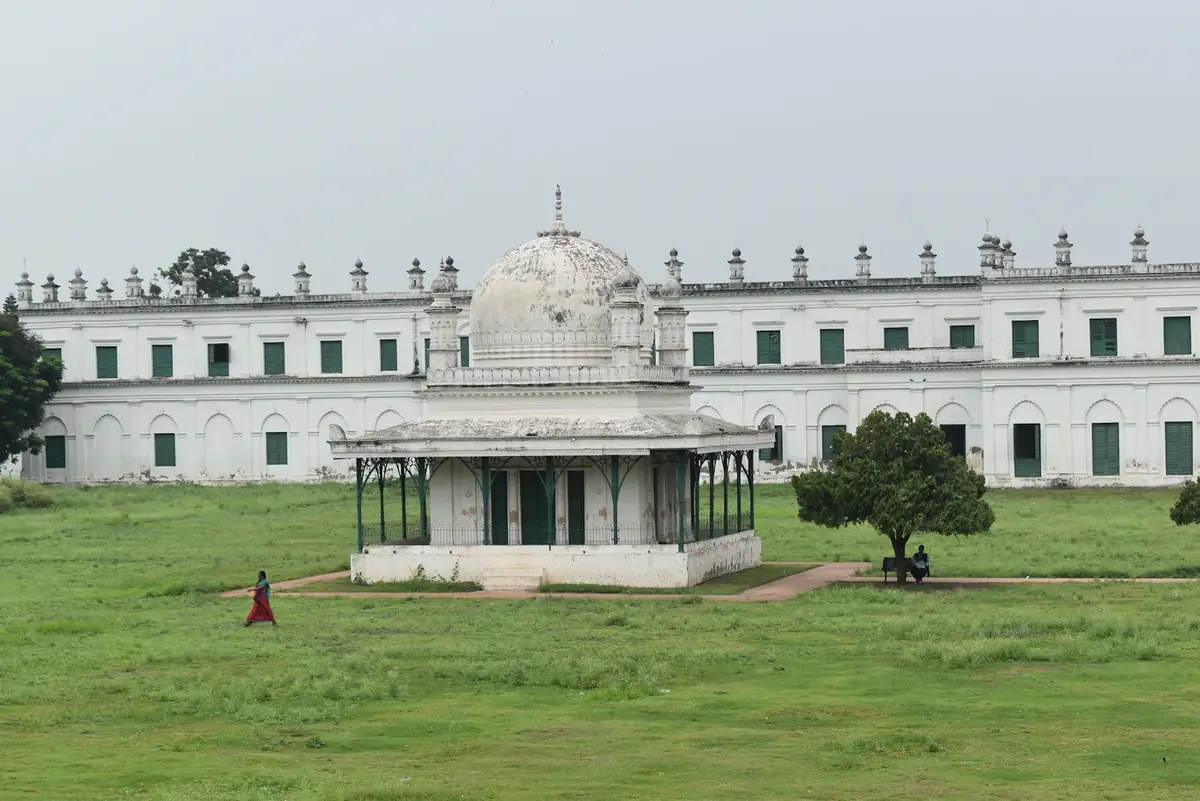
Among the curiosities are a sword said to have belonged to Mir Kasim and an ivory sedan chair. Outside, the clock tower, the old Madina mosque, the Bachhawali cannon and the long white Nizamat Imambara share the same lawns, so allow time for the whole Kila Nizamat. Entry is ticketed by the ASI and the museum has a weekly closing day (it has been Friday); check current timings and fees before you go.
Hazarduari Palace: questions
Who built Hazarduari Palace?
It was built for Nawab Nazim Humayun Jah between 1829 and 1837, designed by Colonel Duncan MacLeod of the Bengal Corps of Engineers.
How many doors does Hazarduari Palace have?
About a thousand, which gives it its name. Many are false; sources disagree on whether about 100 or 110 are real.
Is Hazarduari Palace a museum?
Yes. It is a museum run by the Archaeological Survey of India, with paintings, arms, furniture, a library of manuscripts and a great chandelier.
What else is near Hazarduari Palace?
The Nizamat Imambara faces it across the lawns, with the clock tower and the old Madina mosque between them. Wasif Manzil is on the same campus.