Updated
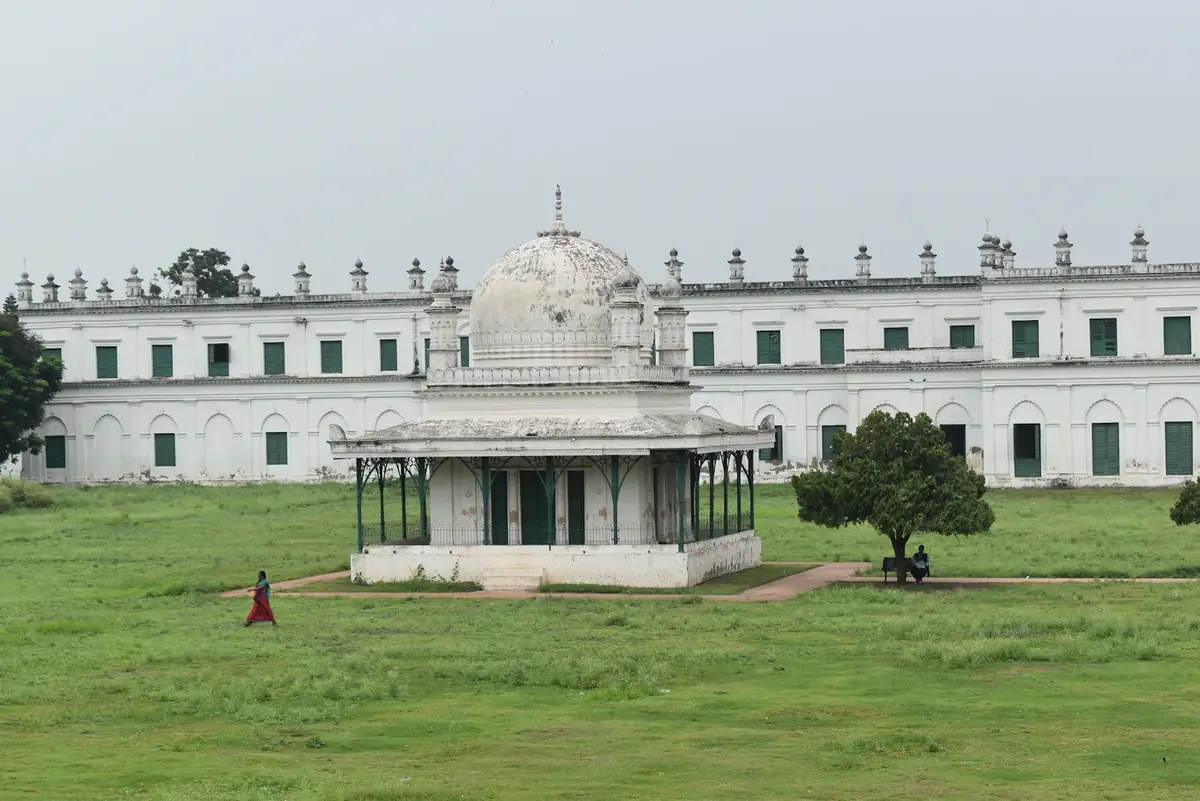
The Katra Masjid is the grandest monument of Murshidabad's founder, Nawab Murshid Quli Khan, who made the town the capital of Bengal. Completed in 1724–25, it was a mosque, a centre of learning and a caravanserai in one, with rows of cells around a great courtyard. Murshid Quli Khan is buried beneath the steps of its eastern entrance, so that those who came to pray would walk over his grave.
History
Two Persian inscriptions on basalt slabs date the building to 1137 AH, that is 1724–25. It is said to be modelled on the Kartalab Khan mosque in Dhaka, and was built in the last years of Murshid Quli Khan's life. He was laid in a small chamber under the fourteen steps of the eastern gateway, a choice usually explained as an act of humility.
The cells around the courtyard, known locally as katra, give the building its name; they housed students and travellers. William Hodges, who visited in the 18th century, described it as a great seminary. The Archaeological Survey of India has protected it since 1910 and it is a Monument of National Importance.
The building
The mosque stands on a platform reached by those eastern steps. Its prayer hall originally had five domes, and there were four tall corner towers. The great earthquake of 1897 brought down two domes and damaged two towers; the surviving towers rise to about 21 m. The building is of brick with basalt details, and accounts say up to 700 people could read or pray here at once.
Even in its half-ruined state the scale is striking, and the walk up through the courtyard to the prayer hall gives a sense of what the Nawabs' capital looked like in its first decades.
Visiting
The mosque lies in the town of Murshidabad a short ride from Hazarduari Palace, and is a regular stop on local sightseeing circuits. The great Jahan Kosha cannon is a short walk away at Topkhana. Entry is ticketed by the ASI; check current fees at the gate.
Katra Masjid: questions
Who is buried at the Katra Masjid?
Nawab Murshid Quli Khan, founder of Murshidabad, is buried in a chamber under the steps of the eastern entrance.
When was the Katra Masjid built?
It was completed in 1724–25, according to two Persian inscriptions on the building.
Why is part of the Katra Masjid in ruins?
The 1897 earthquake brought down two of its five domes and damaged its corner towers.