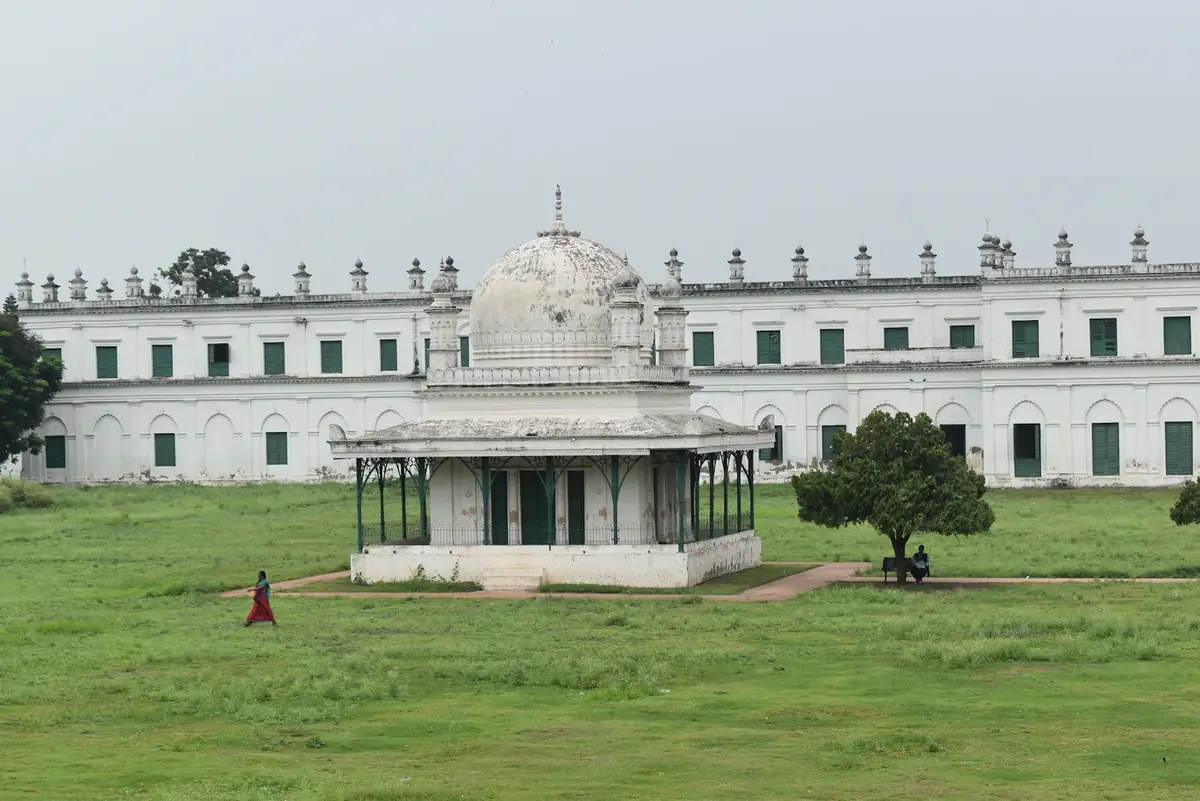
Paschim Banga's forts span many centuries and rulers: the Bhutanese and Lepcha hill forts above the Teesta, the stronghold at Buxa on the Bhutan border, the fortified palace of the Panchet kings, the laterite walls of Kurumbera and the gateways of the sultans' capital at Gour.
Most are ruins in open country, with little shade and few facilities. Go in the cooler months, wear sturdy shoes, and check whether forest or border permits apply.
Kurumbera Fort
Kurumbera Fort is a 15th-century laterite monument in Gaganeshwar village near Keshiary, Paschim Medinipur, known for its great courtyard ringed by a pillared, arcaded corridor. An Odia inscription dates it to the reign of the Gajapati king Kapilendra Deva of Odisha (1438–1469), and a later inscription records additions in the time of Aurangzeb.
Garh Panchkot
Garh Panchkot is the ruined seat of the Panchkot kings at the foot of Panchet Hill, in Neturia block in the north-east of Purulia. It is known for its broken palace walls and gateways, a restored five-spired (pancharatna) temple and other ruined temples, all set against a forested hill.
Buxa Fort
Buxa Fort stands on a forested hill inside Buxa Tiger Reserve, about 30 km from Alipurduar town, on the old route from the plains into Bhutan. Bhutan built it as a gateway outpost, the British took it in 1865, and in the 1930s and 1940s it became one of the most feared detention camps for India's freedom fighters.
Damsang Fort
Damsang Fort, or Damsang Gadi, is a ruined hill fort on a ridge near Pedong, overlooking the Rhenock valley and the old route to the Jelep La. It is remembered as the seat of Gaeboo Achyok, the 17th-century Lepcha chief whom the Lepchas honour as their last king, and it was later a Bhutanese stronghold until the Anglo-Bhutan War of 1864.
Dalim Fort
Dalim Fort, the Daling or Dalingkot of older records, is a ruined hill fort at Dalim Busty above Gorubathan. Before 1865 the hills that now form Kalimpong district were governed from two forts, Damsang near Pedong and Daling, and the whole region was often called Dalingkot after it.
Gar Mandaran
Gar Mandaran is a village about 2 km from Kamarpukur whose grassy mound hides the remains of a medieval fort. The ruins are famous as the setting of Durgeshnandini, Bankim Chandra Chattopadhyay's 1865 historical romance and his first Bangla novel.
Karnagarh
Karnagarh is a village in Salboni block about 10 km north of Medinipur town, known for the Dandeswar and Mahamaya temples, once the temples of the ruling family of Karnagarh, and for the remains of their fort. It is remembered as the seat of Rani Shiromani, who was linked to the Chuar rebellion against the East India Company.
Gadiara
Gadiara is a riverside village in the Shyampur I block of Howrah district, known for its wide view over the meeting of the Rupnarayan with the Hooghly, with the Damodar joining close by. It is famous for sunsets over the water and for the ruins of Fort Mornington, a British fort said to have been built by Robert Clive after the Battle of Plassey, which now shows only at low tide.
Dakhil Darwaza
The Dakhil Darwaza is the grand northern gateway to the citadel of Gour, and one of the most impressive brick structures in Bengal. Dakhil means entrance, and it was the main way into the walled royal enclosure of the sultans.
Lukochuri Darwaza
The Lukochuri Darwaza is a tall Mughal gateway at Gour, an eastern entrance to the old citadel. Its name means hide and seek in Bangla, and it is also recorded as the Lakhchhipi Darwaza.
Bangarh (Gangarampur)
Bangarh is the most important archaeological site in Dakshin Dinajpur: the buried remains of Kotivarsha, a city that flourished for well over a thousand years on the east bank of the Punarbhaba river at Gangarampur. It is famous for its long history, from an early settlement of the last centuries BCE through the Gupta and Pala periods to Devkot, where Bakhtiyar Khalji, who brought Muslim rule to Bengal, died in 1205–06.
Gosanimari
Gosanimari is a village near Dinhata in Cooch Behar district, famous for the Kamteswari temple and for Rajpat, the great earthen mound held to be the remains of Kamatapur, capital of the medieval Kamata kingdom. The present temple was built in 1665 by Maharaja Pran Narayan of Cooch Behar, and Rajpat is protected by the Archaeological Survey of India.