Updated
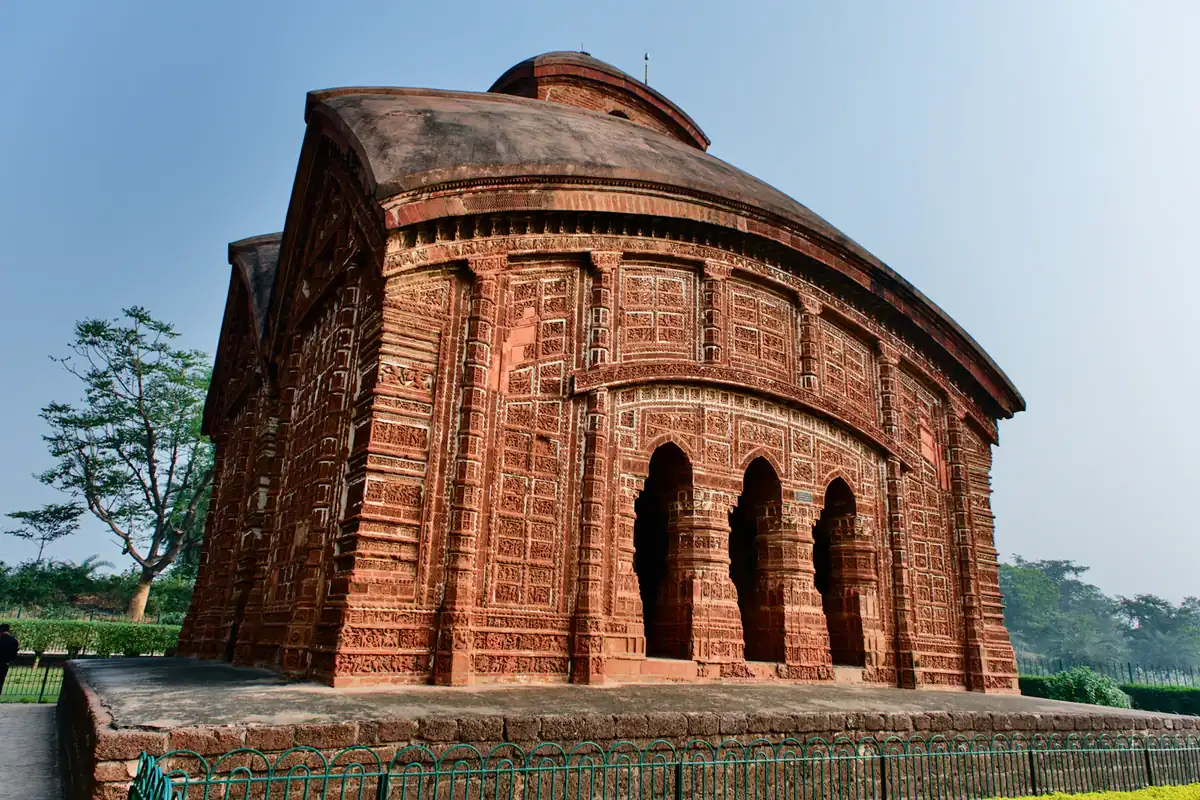
Jor Mandir is a group of three single-spired temples in Bishnupur, built in 1726 under the Malla kings in the rust-red local laterite. Two large temples stand on either side of a much smaller one, and their walls carry carved scenes from the Ramayana and from Krishna's life. The group is protected by the Archaeological Survey of India and is part of the Temples of Bishnupur on UNESCO's tentative list.
Architecture
Each of the two large temples has a square base of about 11.7–11.8 m and rises to about 12.2–12.8 m above a low platform. The small central temple is about 7 m square and 7.6 m high. All three follow the ekaratna plan, with a curved, chala-style roof topped by a single tower, and the larger temples have covered porches with arched openings.
Because laterite is coarse and porous, the decoration here is cut into the stone and finished in stucco rather than made from fired clay panels. Look for scenes from the Ramayana and Krishna-lila along the walls and around the arches.
History
Sources differ on the builder: Wikipedia credits King Gopal Singha, while the district administration names Krishna Singha. The temples are dedicated to Narayana (Vishnu). They stand in the Poramatir Haat area of the town.
The 1726 date places the group near the end of Bishnupur's great temple-building century, after the brick temples of Raghunath Singha and Durjan Singha and before the Maratha raids of the 1740s.
Visiting Jor Mandir
Jor Mandir is part of the circuit of ASI-protected temples in Bishnupur; entry is ticketed, so check current fees at the counter. The group is easy to reach by toto and combines well with Lalbandh, one of the lakes dug by the Malla kings, and with the Radha Shyam and Lalji temples. Laterite glows a deep red in low sun, so early morning or late afternoon is the best time for photographs.
Compare the carving here with the fired-clay panels of the Shyam Rai and Jor Bangla temples: the laterite gives a rougher, more weathered surface, but the stucco figures on the larger temples are still clear in places.
Jor Mandir: questions
How many temples are in the Jor Mandir group?
Three: two large temples and a smaller one between them.
When was Jor Mandir built?
In 1726.
Who built Jor Mandir?
Sources differ: some credit King Gopal Singha, others Krishna Singha.
What is Jor Mandir made of?
Laterite, the rust-red local stone, with carved and stucco decoration.