Updated
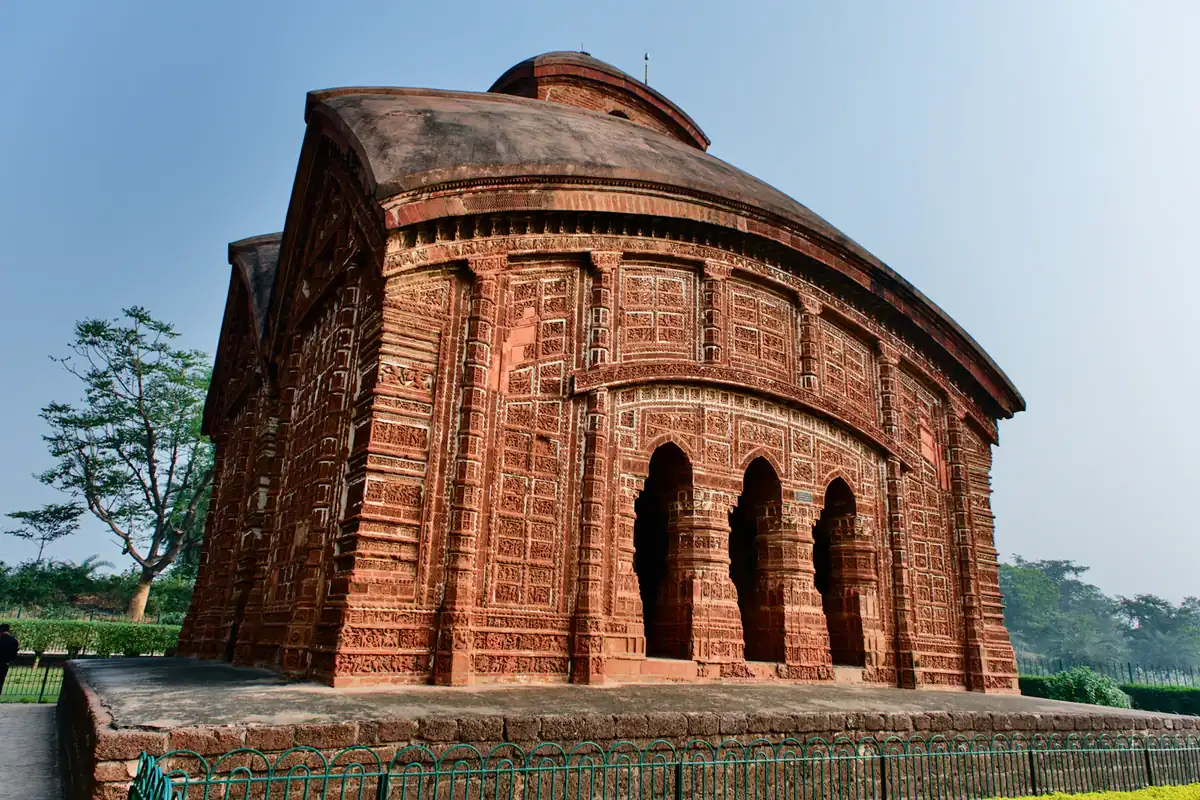
The Lattan Masjid, or Lotan Masjid, is a single-domed brick mosque at Gour known as the Painted Mosque. It is the best place in the ruined city to see the glazed, multicoloured tiles that once covered many of Gour's buildings. Its date and builder are uncertain, but it belongs to the late 15th or early 16th century, the high point of the Bengal Sultanate.
Date and the legend of Lotan Bibi
No inscription on the mosque itself names its builder. An inscription found nearby may point to Sultan Shamsuddin Yusuf Shah, who reigned from 1474 to 1481, and Encyclopaedia Britannica is cited as dating the mosque to about 1475–1480. Other historians, judging by style, place it in the Husain Shahi period, about 1493–1519. Alexander Cunningham linked the nearby inscription to a different mosque.
Local tradition tells a more romantic story. Yusuf Shah is said to have married a dancer named Mira, who took the name Lotan Bibi; the sultan then founded an estate named after her, the Lotan Taluq, which included the mosque and the Lotan Dighi tank and survived into the British period. The story explains the name but is not confirmed by records.
Architecture and tiles
The mosque stands on a platform about 22 m east to west and 15.5 m north to south. The square prayer chamber, about 10.4 m a side, is covered by a single dome, and a verandah runs across the front. Much of the outer cladding of glazed tiles has been lost, but inside there are still numerous coloured tiles, which give the building its popular name.
Glazed and enamelled brickwork was a feature of late sultanate Gour; fading traces also survive on the Gumti Darwaza. The Lattan Masjid is notable as one of the buildings that still retains its tiles.
Visiting the Lattan Masjid
The mosque is a Monument of National Importance (N-WB-92) maintained by the ASI and is no longer used for prayer. It lies a short way north of the Dakhil Darwaza, on the Gour circuit from Malda town. Look closely at the interior walls for surviving tiles.
Lattan Masjid: questions
Why is the Lattan Masjid called the Painted Mosque?
Because of its multicoloured glazed tiles, many of which still survive inside.
Who built the Lattan Masjid?
The builder is not certain. A nearby inscription may point to Sultan Shamsuddin Yusuf Shah (1474–1481); other historians date it to the Husain Shahi period.
Who was Lotan Bibi?
According to local tradition, a dancer named Mira who married Sultan Yusuf Shah and took the name Lotan Bibi. The mosque's name is linked to her estate, the Lotan Taluq.
Is the Lattan Masjid still used for prayer?
No. It is an ASI-protected monument and inactive as a mosque.