Updated
The Kapil Muni Temple stands near the southern tip of Sagar Island, where the Hooghly, the main channel of the Ganges in Paschim Banga, enters the Bay of Bengal. It is dedicated to the sage Kapil Muni, who is believed to have meditated here, and it is the focus of the Gangasagar pilgrimage: after bathing at the confluence, pilgrims come to the temple to offer worship. The present building dates only from 1974, but a shrine has stood near this spot for many centuries.
The legend of Kapil Muni and King Sagar
According to the story, King Sagar's sacrificial horse was stolen by the god Indra and hidden beside the ashram of Kapil Muni, a sage regarded as an incarnation of Vishnu. The king's 60,000 sons found it there and accused the sage of theft. In his anger Kapil Muni burned them to ashes. Later, moved by the prayers of King Sagar's descendants, he agreed that they could be freed if the Ganga came down to earth and flowed over their ashes. The descent of the Ganga to the sea at this spot is what makes the confluence sacred, and it is why the place is called Gangasagar.
History of the temple
A temple is said to have stood here in the Gupta period, but it was lost to the sea. In the early 19th century, after the island was cleared under Warren Hastings, a local zamindar named Yaduram recovered the shrine, and it later passed into the care of Ramanandi sadhus from Ayodhya. For many years the temple was a bamboo structure; it was destroyed by cyclones around the late 1950s or early 1960s.
The first brick temple was built in 1961 for about ₹20,000, with an asbestos roof; the former chief minister Bidhan Chandra Roy contributed ₹11,000. The present, larger temple was built in 1974. Because it stands so close to the river mouth and the sea, high tides and cyclonic storms sometimes flood the temple grounds, as happened during Cyclone Yaas in May 2021.
Visiting the temple
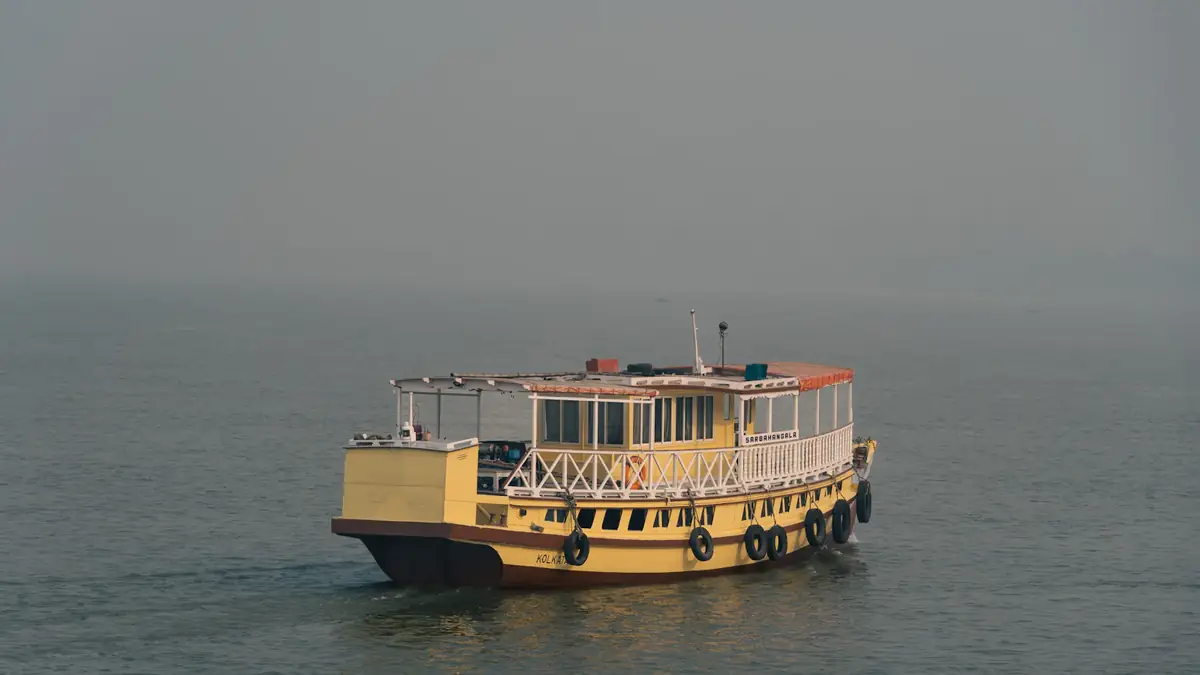
Most visitors reach Sagar Island by ferry from Harwood Point (Lot 8), near Kakdwip, to Kachuberia at the north end of the island, and then travel by bus or car to the southern tip. Outside the January festival the temple and beach are quiet and windswept, and the temple can be combined with a walk to the confluence. During Makar Sankranti, when millions come for the Gangasagar Mela, expect huge crowds, special transport arrangements and long queues.
Kapil Muni Temple: questions
When was the Kapil Muni Temple built?
The present temple dates from 1974. It replaced a smaller brick temple of 1961, which in turn replaced older bamboo structures.
Who was Kapil Muni?
A sage regarded as an incarnation of Vishnu. Legend says King Sagar's sons were burned to ashes for accusing him of theft, and were freed when the Ganga descended to the sea here.
How do you reach the Kapil Muni Temple?
Take the ferry from Harwood Point (Lot 8) near Kakdwip to Kachuberia on Sagar Island, then a bus or car to the southern tip of the island.
Is the Kapil Muni Temple affected by the sea?
Yes. Sea and river water sometimes enter the temple grounds at high tide or during cyclones, as during Cyclone Yaas in 2021.