Updated
Bahulara is a village in Onda block of Bankura, on the bank of the Dwarakeswar river, known for the Siddheswar temple, a tall brick rekha deul of the early medieval period. The historian Nalini Kanta Bhattasali called it probably the finest brick-built rekha temple of the period still standing in Bengal. It is a Monument of National Importance protected by the Archaeological Survey of India, about 25 km from Bishnupur.
Things to do in Bahulara
Siddheswar temple
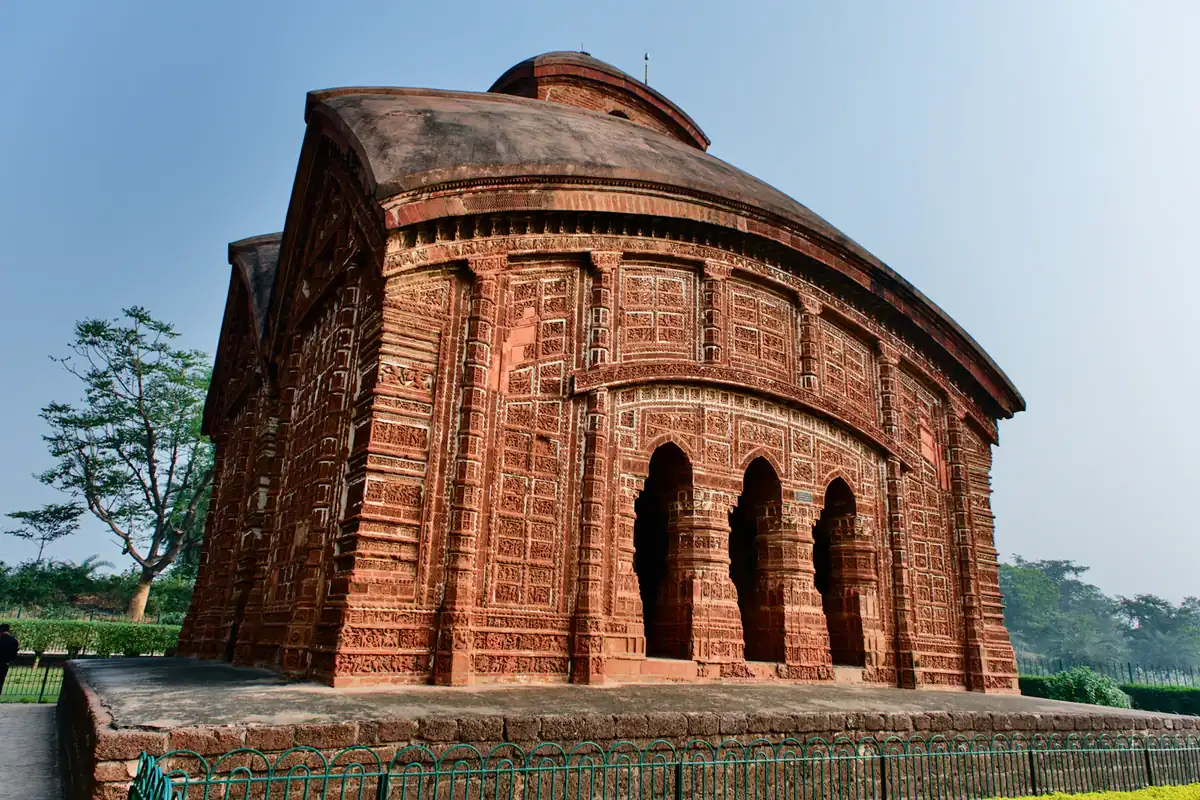
A brick rekha deul about 19 m tall, its curved spire decorated with cut brick and lime stucco; Shiva is worshipped here as Siddheswar.
Images in the sanctum
Alongside the Shiva linga are figures of Ganesha, Mahishasuramardini and the Jain Tirthankara Parshvanatha, hints of the site's mixed past.
Mounds around the temple
Low mounds nearby are thought by archaeologists to be the remains of Buddhist stupas.
Dwarakeswar river
The river flows past the village, with wide sandbanks in the dry season.
Gajan festival
The Shiva Gajan in Chaitra (March–April) runs over three days and draws hundreds of devotees.
History of the Siddheswar temple
The temple's date is uncertain. It is generally placed between the 8th and 12th centuries; the most common estimate is the 11th–12th century. Some scholars think the site began as a Jain or Buddhist shrine and was later reconsecrated to Shiva under the Malla kings of Bishnupur. The image of Parshvanatha inside the sanctum and the mounds believed to be Buddhist stupas support the idea of a mixed religious history.
The temple is listed by the Archaeological Survey of India as a Monument of National Importance. Its top, the amalaka, was damaged in the past, and much of the original surface decoration has been lost, but the government has carried out restoration work.
Architecture
Siddheswar is a rekha deul: a square sanctum under a tall, gently curving tower in the Nagara manner, built entirely of brick. It rises about 19.2 m (63 ft). The surface was decorated with carved brick and lime stucco, much of which has been lost.
It is counted among the oldest temples of its type in Bengal, comparable with the brick deuls of Deulghata in Purulia. Inside, the sanctum holds a Shiva linga with figures of Ganesha, Mahishasuramardini and Parshvanatha.
How to reach Bahulara
By train. Ondagram station, on the Kharagpur–Bankura line, is about 5 km away. Bankura and Bishnupur junctions have more trains from Howrah; check current timings with Indian Railways.
By road. Bahulara is about 25 km from Bishnupur; hired cars from Bishnupur or Bankura are the easiest option.
By air. Kolkata (CCU) is the nearest major airport.
Bahulara: travel questions
What is Bahulara famous for?
Bahulara is a village in Onda block of Bankura, on the bank of the Dwarakeswar river, known for the Siddheswar temple, a tall brick rekha deul of the early medieval period. The historian Nalini Kanta Bhattasali called it probably the finest brick-built rekha temple of the period still standing in Bengal.
What is the best time to visit Bahulara?
The best time to visit Bahulara is November to March.
How far is Bahulara from Kolkata?
Bahulara is about 155 km from Kolkata by road, about 4 hours by car depending on traffic.
How do I reach Bahulara?
By air: the nearest airport is Netaji Subhas Chandra Bose International Airport (CCU), Kolkata, about 4.5 hours by road. By train: Ondagram (about 5 km), or Bankura and Bishnupur. By road: about 155 km from Kolkata.
What are the places to visit near Bahulara?
Places near Bahulara include Bishnupur (about 14 km), Bankura (about 18 km), Panchmura (about 25 km) and Gangani (about 35 km). Distances are in a straight line.
How tall is the Bahulara temple?
About 19.2 m (63 ft).
Is the Bahulara temple protected?
Yes. The Bahulara Ancient Temple is a Monument of National Importance under the Archaeological Survey of India.
Which deity is worshipped at Bahulara?
Shiva, as Siddheswar Mahadeva. Figures of Ganesha, Mahishasuramardini and the Jain Tirthankara Parshvanatha are also in the sanctum.
When is the Bahulara Gajan?
The Shiva Gajan is held over three days in the month of Chaitra (March–April).